October 31, 2025
Marking the 25th anniversary of UN Security Council Resolution 1325 with a survivor-centred perspective
On 16 October 2025, the Mukwege Foundation, in collaboration with UN Women and the Embassy of Ireland in Kampala, Uganda, organised an event marking the 25th anniversary of United Nations Security Council Resolution 1325 on Women, Peace and Security (WPS). The event brought together survivors of conflict-related sexual violence (CRSV), the Honourable Minister of State for Gender and Culture for Uganda, ambassadors and representatives of diplomatic missions, as well as government officials and civil society partners, for an afternoon of reflection, dialogue, and collective action.
The event followed a two-and-a-half-day learning exchange convened by the Mukwege Foundation from 14 to 16 October, which brought together survivor leaders from eight national networks — from the Central African Republic, the Democratic Republic of Congo, Ethiopia, South Sudan, Sudan, Ukraine, and Uganda. As the largest survivor exchange ever organised by the Mukwege Foundation, the gathering created a rare and powerful space for survivor activists to exchange experiences on supporting their peers, managing their network, advancing survivor participation in transitional justice and the WPS agenda, and driving survivor-led advocacy and awareness efforts.
Resolution 1325: progress, challenges, and the road ahead
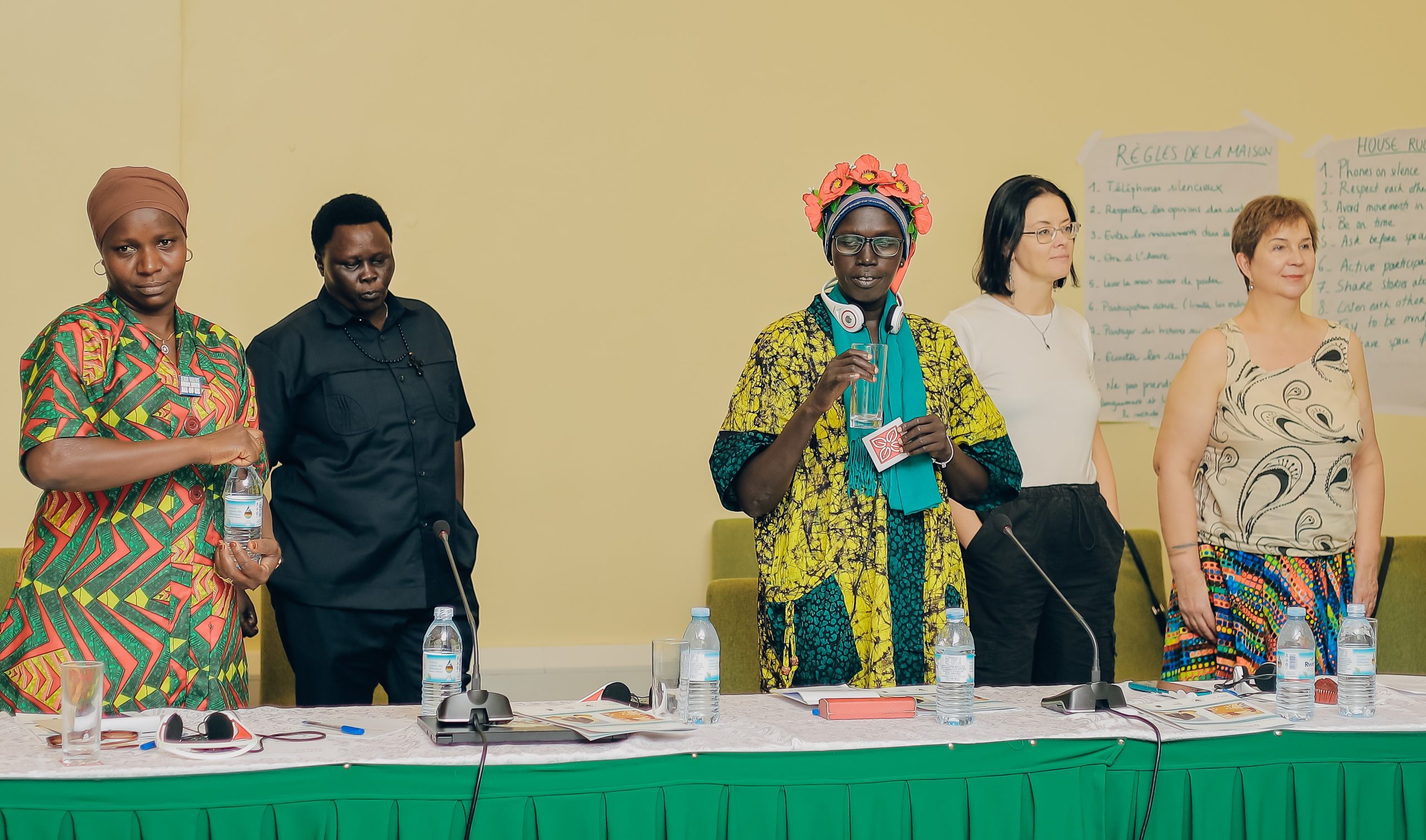
Survivor leaders during the largest national survivor exchange organised by the Mukwege Foundation ahead of the public event.
Twenty-five years after its adoption, UN Security Council Resolution 1325 continues to serve as a cornerstone for women’s participation and leadership in peace processes. It recognised for the first time that women and girls experience conflict differently, and that their participation is essential to building and sustaining peace. Yet, the world today faces a troubling reversal of many hard-won women’s rights. Across regions, gender-equality gains are being rolled back, civic space for women’s rights defenders is shrinking, and humanitarian aid budgets are under strain. Survivors of CRSV continue to face stigma, exclusion, and threats to their safety.
Resolution 1325 rests on four interconnected pillars —protection, participation, prevention, and recovery— outlining a vision for inclusive peace and gender-sensitive security. Yet, despite this framework, conflict-related sexual violence remains one of the most persistent and devastating violations in war. For survivors, the promises of 1325 are often still out of reach: justice remains elusive, and avenues for meaningful participation are limited.
Through its work, the Mukwege Foundation seeks to close this gap by amplifying survivors’ voices and positioning them as essential actors in peacebuilding and policy-making. The event in Kampala highlighted this approach, focusing on the power of survivor networks as engines for solidarity, advocacy, and accountability across borders.
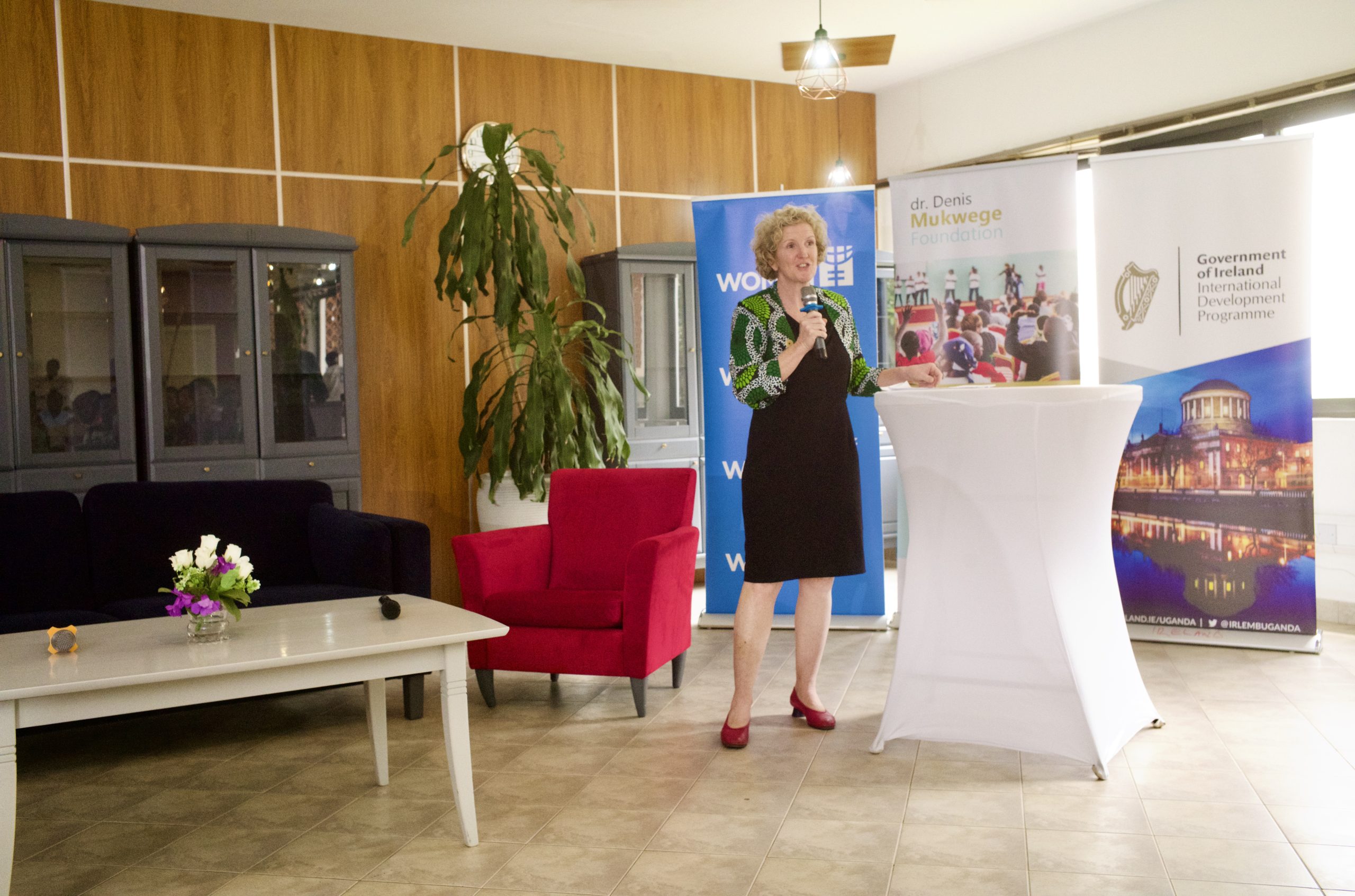
H.E. Mags Gaynor, Ambassador of Ireland to Uganda and Rwanda, delivering remarks at the opening of the event.
In her keynote remarks, Ambassador Mags Gaynor of the Embassy of Ireland underscored the need to ensure that survivors are meaningfully included in shaping the processes that directly concern them. She reflected that listening to survivors and witnessing their persistence had reaffirmed her belief in the continued importance of the WPS agenda, noting that, “Despite the setbacks we are all experiencing, we cannot give up.”
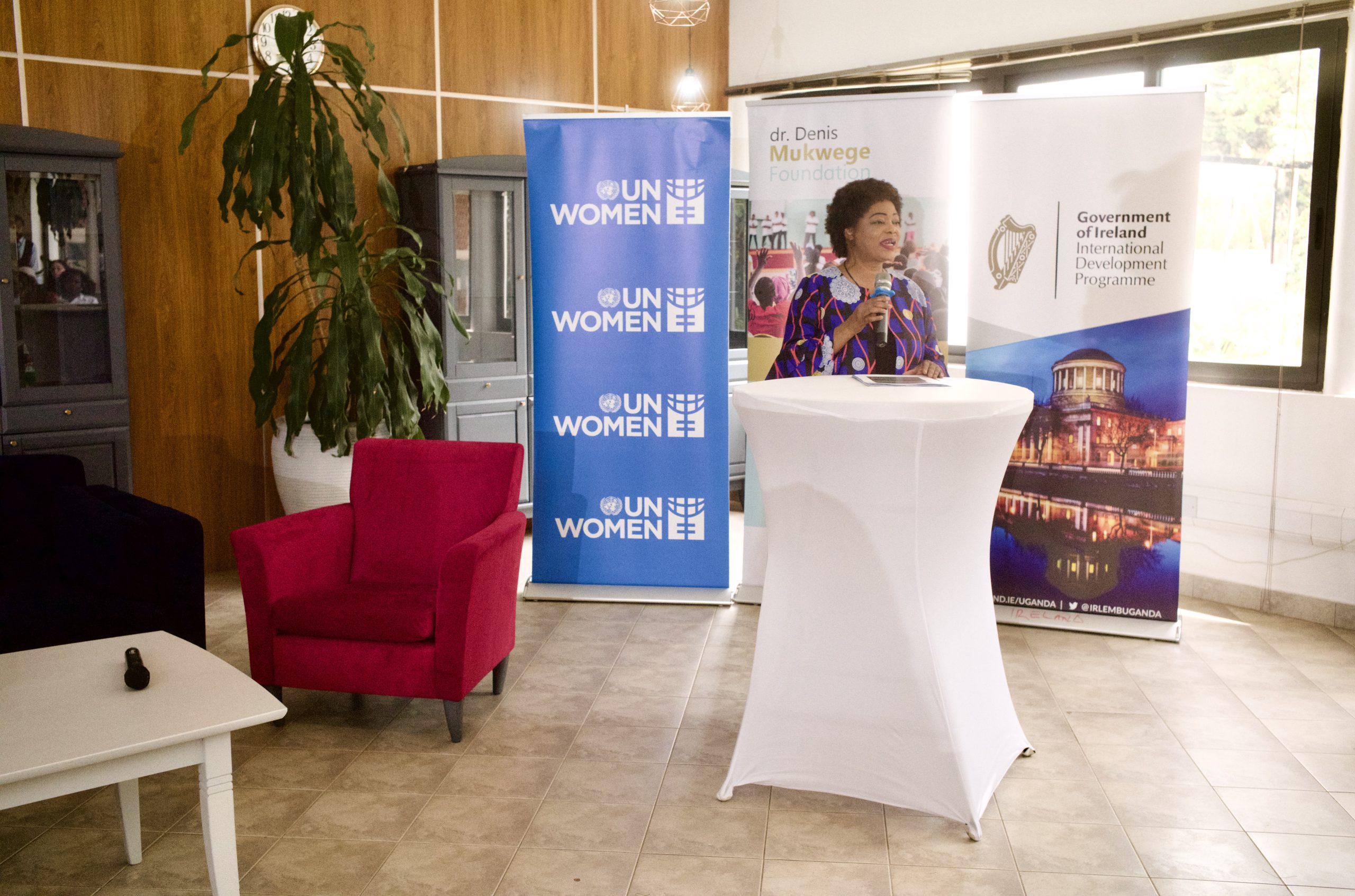
Dr Paulina Chiwangu, UN Women Country Representative in Uganda, delivering remarks at the opening of the event.
Dr Paulina Chiwangu, UN Women Uganda Country Representative, emphasised that survivors’ voices must remain at the centre of all WPS processes and stressed that the next five years should be a period of accelerated action. As conflict becomes more complex, including through the effects of climate change and the rise of digital technologies, women’s resilience remains constant. She called for increased investment in the next generation of women peacebuilders and greater accountability across sectors.
“When women lead, peace follows.”
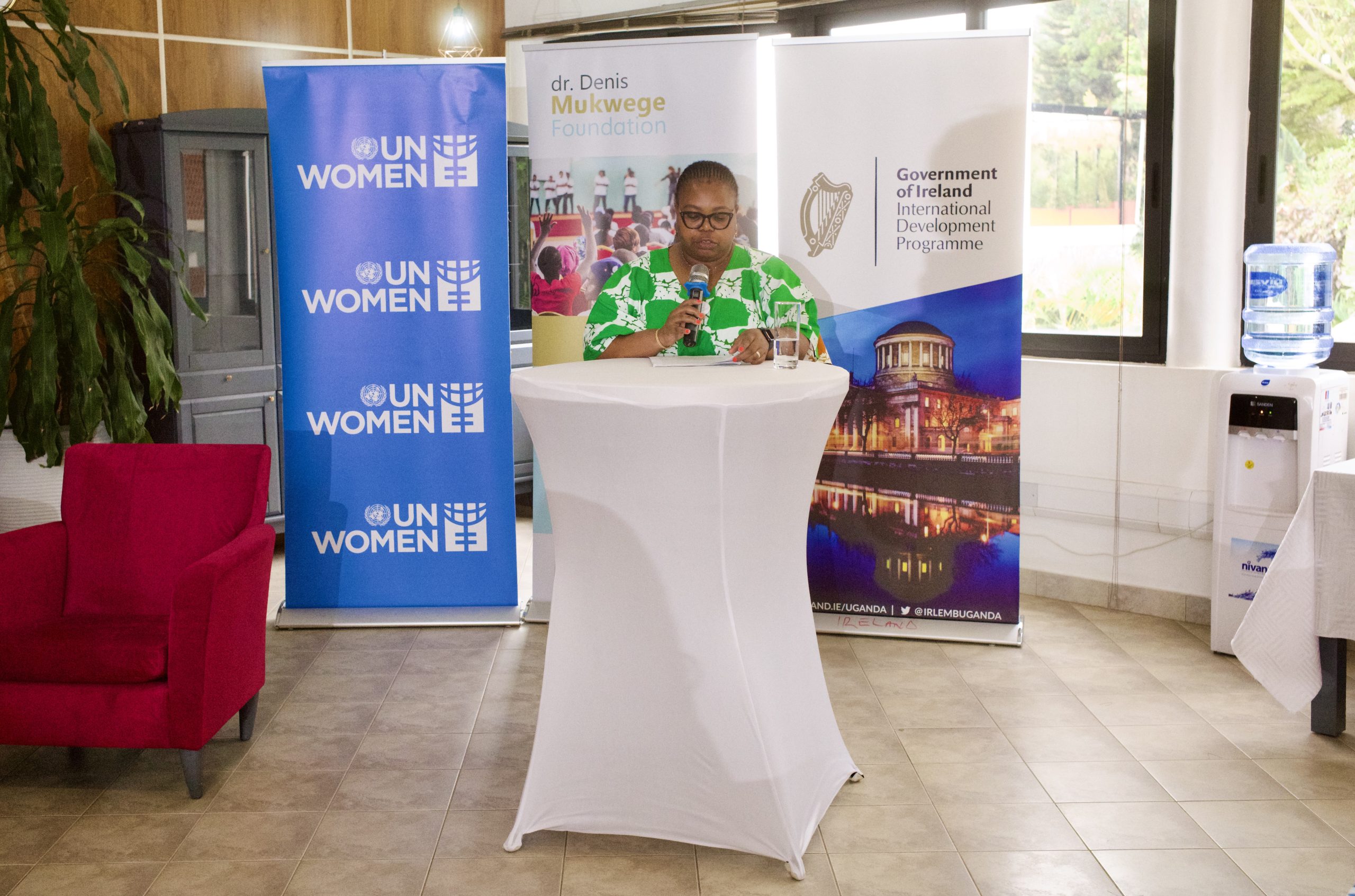
Tatiana Mukanire, survivor leader from the Democratic Republic of the Congo and SEMA member, delivering remarks at the opening of the event.
Speaking on behalf of the SEMA Network, Tatiana Mukanire, from the Democratic Republic of the Congo, reflected that SEMA members representing survivors from 29 countries share not only a painful history but also a collective courage to build peace together. She called for justice mechanisms that place survivors at the centre and urged governments and international actors to ensure survivors are active participants in rebuilding their communities. Her message reaffirmed SEMA’s guiding principle: “Nothing About Us, Without Us.”
“We cannot rewrite the past. But together, we have the power to transform the present and build a future where such atrocities will never happen again,” she said.
Katrien Coppens, Executive Director of the Mukwege Foundation, reflected that the essential task before us is clear: to amplify the voices of survivors, not as beneficiaries of policy, but as a vital constituency for justice and peace. She emphasised that today’s focus on the power of networks of survivors of conflict-related sexual violence could not be more urgent.
“As we look toward the next 25 years, let Kampala be remembered as the place where survivors stood together, recognised not as symbols of suffering, but as leaders of peace and justice,” she concluded.
Not every closed door is locked: Survivor leadership in the WPS Agenda
In the video, from left to right: Katrien Coppens, Executive Director of the Mukwege Foundation; Malala Mojwok and Sylvia Acan, SEMA members; Natasha Butorac, Programme Specialist, Women, Peace and Security at UN Women Uganda; and Stella Sabiiti, Peace and Security Expert and Policymaker.
The opening remarks were followed by an interactive panel discussion moderated by Katrien Coppens. The panel brought together Sylvia Acan, SEMA member and Director of Golden Women Vision Uganda; Malala John Mojwok Anydu, National Coordinator of Survivors’ Network in South Sudan (SUNS); Stella Sabiiti, Peace and Security Expert, and Natasha Butorac, Programme Specialist Women Peace and Security, UN Women Uganda.
- Sylvia stressed that women must be part of every peace process, noting that survivors bring essential perspectives to reconciliation and recovery. She defined justice as recognition and reparations and called for education support for children born of war, as well as psychosocial care to help survivors heal and lead.
- Malala shared that in South Sudan, survivors were once excluded from transitional justice mechanisms but are now represented in the Commission for Truth, Reconciliation and Healing and the Compensation and Reparation Authority. She emphasised that survivor networks are key to achieving peace.
- Stella reflected on her work with the African Union, reminding participants that policies have meaning only when implemented. She urged greater attention to trauma and mental health and stressed that advocacy must continue to close the gap between policy and practice.
- Natasha highlighted Uganda’s progress in localising the WPS agenda, with 20 districts now implementing local action plans. She described how district-level task forces and national committees offer opportunities for survivor networks to contribute directly to the implementation of the WPS agenda in the country.
The session concluded with Stella encouraging young women to claim leadership spaces and for men and women to work together toward peace. “We are celebrating 25 years of 1325,” she said, “and must remember that its core is protection from harm and inclusion for all women, men, and children.” She reminded the audience that progress requires persistence, recalling the words of a former President of Liberia:
“Not every closed door is locked. Sometimes we push, fall, and rise again — only to realise it was never locked at all.”
In her closing remarks, the Minister of State for Gender and Culture reaffirmed her government’s commitment to advancing the Women, Peace and Security agenda and to working alongside survivors. Her message sent a strong signal of solidarity to the survivors in the room — including Ugandan women affected by the Lord’s Resistance Army conflict — and underscored the shared responsibility of governments, civil society, and communities to ensure that all women can live free from violence.
Thank you
This event was made possible through the support of UN Women Uganda and the Embassy of Ireland, and through the participation of the Ministry of Gender Labour and Social Development, the many civil society organisations, embassies, and high-level representatives who attended the event. We also want to thank all the survivor networks for their unwavering courage, active engagement and leadership throughout the learning exchange and event.
The Mukwege Foundation also acknowledges the generous support of its donors, the UN Trust Fund to End Violence Against Women and Girls, the Dutch Ministry of Foreign Affairs, the International Centre for Transitional Justice (ICTJ) and the CDCS (Centre de crise et de soutien from the French Ministry of Foriegn Affairs), whose continued support made this learning exchange and public event possible.